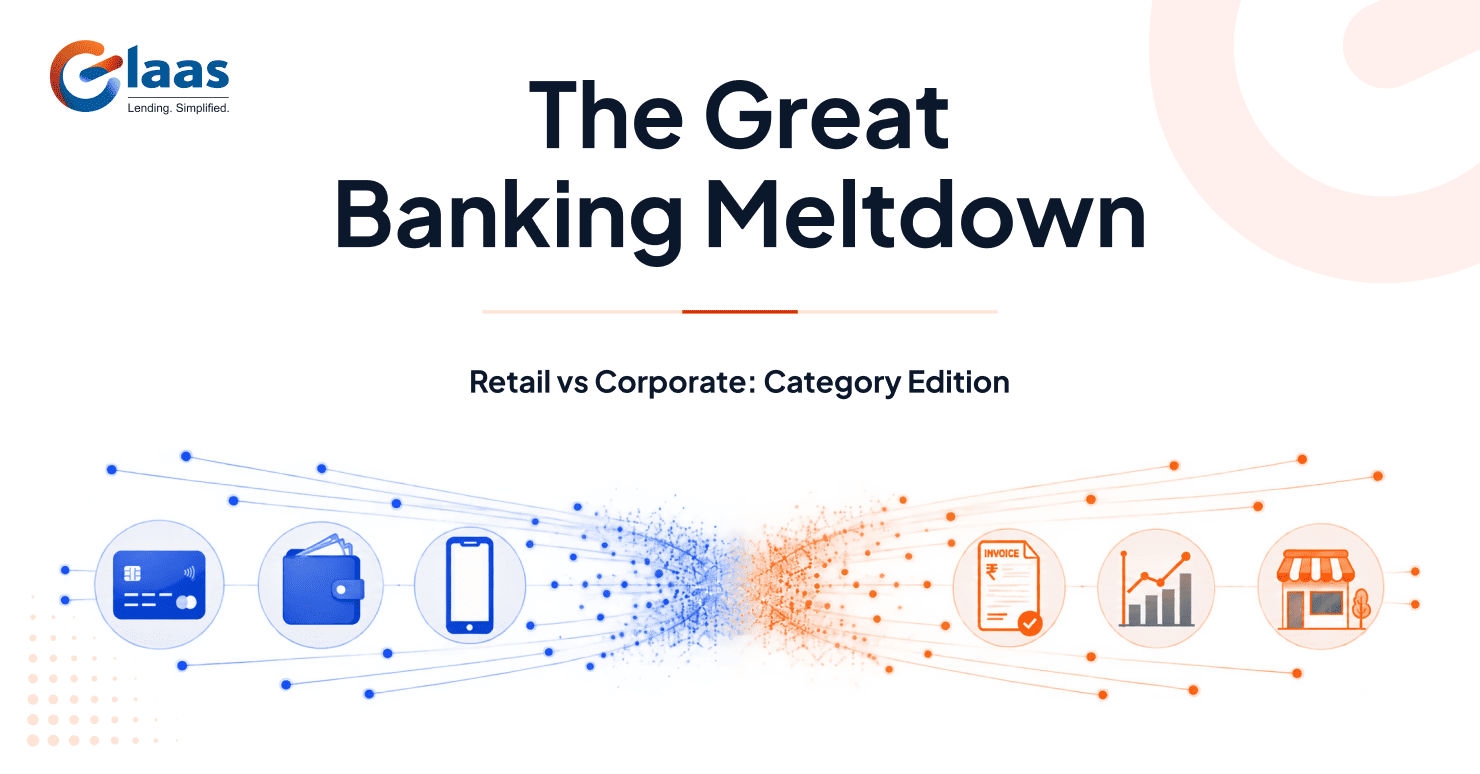
For decades, the financial services playbook was written in stone:
- Retail was high-volume and simple.
- Corporate was low-volume, complex, and relationship-driven.
That playbook isn’t just being revised, it’s being torn up. It is experiencing complete category erosion.
The modern customer has broken the silos. Today, we are witnessing a double-sided convergence that traditional bank architectures are struggling to handle.
1. The Consumerization of the MSME
Business owners are no longer comparing their commercial banking experience to other banks. They are comparing it to how they use Amazon, Uber, or how fast money moves with UPI.
According to Salesforce, 80% of customers now expect the experience a company provides to be as important as its products and services.
An MSME applying for a working capital loan expects retail-like instant digital underwriting, clean APIs, and zero paperwork.
2. The “Institutionalization” of the Retail User
Conversely, the individual retail consumer is no longer just a simple salary earner. With the explosion of the gig economy and side hustles, the modern individual operates like a micro-corporation.
They want corporate-style sophistication, dynamic cash flow management, automated tax routing, and contextual lending at the point of need.
And here’s the contrast.
Traditional banks that maintain rigid internal org structures (separate product teams, disconnected tech stacks, and distinct risk models for retail vs. commercial) are facing a massive bottleneck.
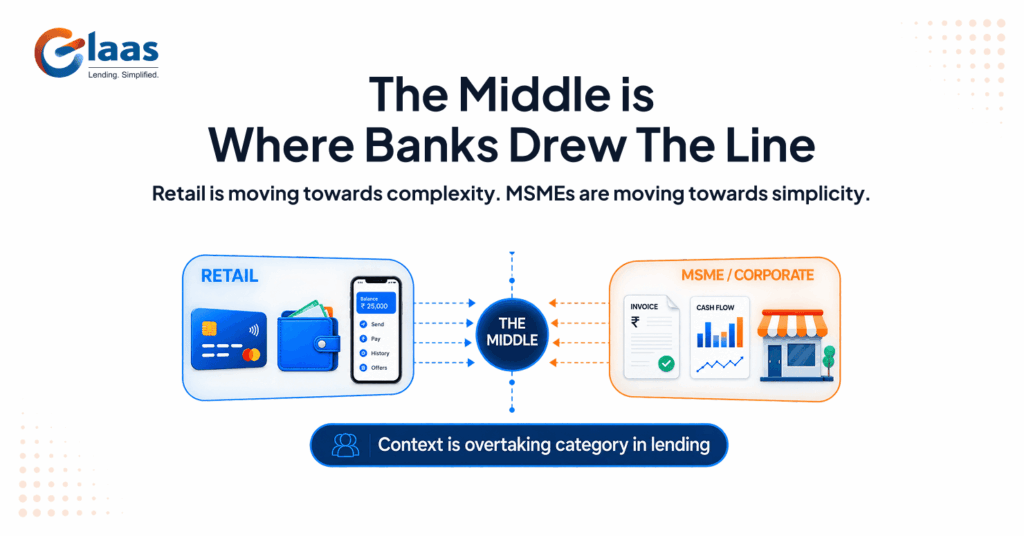
On the other hand, fintechs and digital platforms don’t see “Retail” or “Corporate.” They see an economic unit with cash inflows and outflows that needs a seamless interface. Both of them now sit in the middle, and the middle is exactly where traditional banks drew the line.
This is where GLAAS Comes In
Instead of forcing borrowers into rigid, legacy labels like “Corporate” or “Retail,” GLAAS operates on a unified, context-first philosophy.
As a comprehensive, asset-light embedded credit infrastructure, GLAAS decouples lending from legacy banking drawers. It allows any digital ecosystem—whether a B2B supply chain, a gig-economy marketplace, or a consumer platform—to embed credit directly at the point of need.
By centering the infrastructure around real-time cash flows, transaction velocity, and behavioral data rather than static legal entities, GLAAS transforms credit from a slow, paper-heavy approval process into an instantaneous feature. The focus shifts entirely from who the borrower is to what the economic context demands.
The future of lending doesn’t belong to banks with the best, but siloed products; it belongs to the those that can put real working capital in front of a merchant without making them fill out dozens of forms.