For decades, the financial services playbook was written in stone:
Retail was high-volume and simple.
Corporate was low-volume, complex, and relationship-driven.
That playbook isn’t just being revised, it’s being torn up. It is experiencing complete category erosion.
The modern customer has broken the silos. Today, we are witnessing a double-sided convergence that traditional bank architectures are struggling to handle.
1. The Consumerization of the MSME
Business owners are no longer comparing their commercial banking experience to other banks. They are comparing it to how they use Amazon, Uber, or how fast money moves with UPI.
According to Salesforce,80% of customersnow expect the experience a company provides to be as important as its products and services.
An MSME applying for a working capital loan expects retail-like instant digital underwriting, clean APIs, and zero paperwork.
2. The “Institutionalization” of the Retail User
Conversely, the individual retail consumer is no longer just a simple salary earner. With the explosion of the gig economy and side hustles, the modern individual operates like a micro-corporation.
They want corporate-style sophistication, dynamic cash flow management, automated tax routing, and contextual lending at the point of need.
And here’s the contrast.
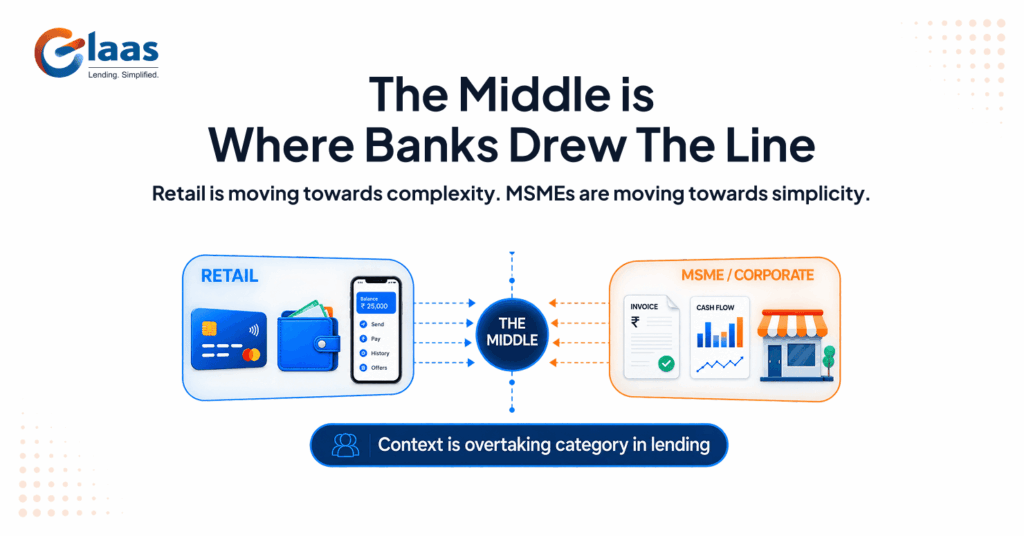
Traditional banks that maintain rigid internal org structures (separate product teams, disconnected tech stacks, and distinct risk models for retail vs. commercial) are facing a massive bottleneck.
On the other hand, fintechs and digital platforms don’t see “Retail” or “Corporate.” They see an economic unit with cash inflows and outflows that needs a seamless interface. Both of them now sit in the middle, and the middle is exactly where traditional banks drew the line.
This is where GLAAS Comes In
Instead of forcing borrowers into rigid, legacy labels like “Corporate” or “Retail,” GLAASoperates on a unified, context-first philosophy.
As a comprehensive, asset-light embedded credit infrastructure, GLAAS decouples lending from legacy banking drawers. It allows any digital ecosystem—whether a B2B supply chain, a gig-economy marketplace, or a consumer platform—to embed credit directly at the point of need.
By centering the infrastructure around real-time cash flows, transaction velocity, and behavioral data rather than static legal entities, GLAAS transforms credit from a slow, paper-heavy approval process into an instantaneous feature. The focus shifts entirely from who the borrower is to what the economic context demands.
The future of lending doesn’t belong to banks with the best, but siloed products; it belongs to the those that can put real working capital in front of a merchant without making them fill out dozens of forms.
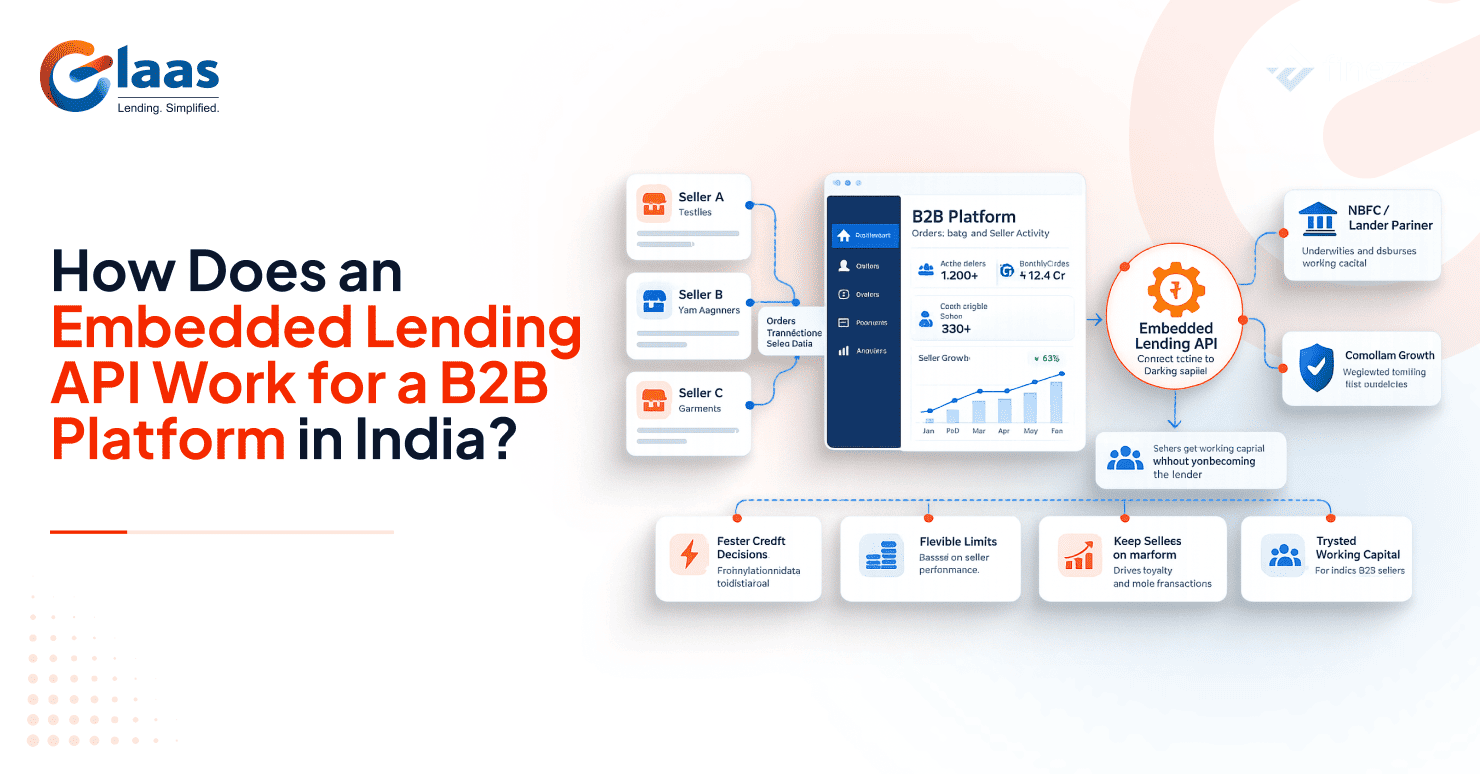
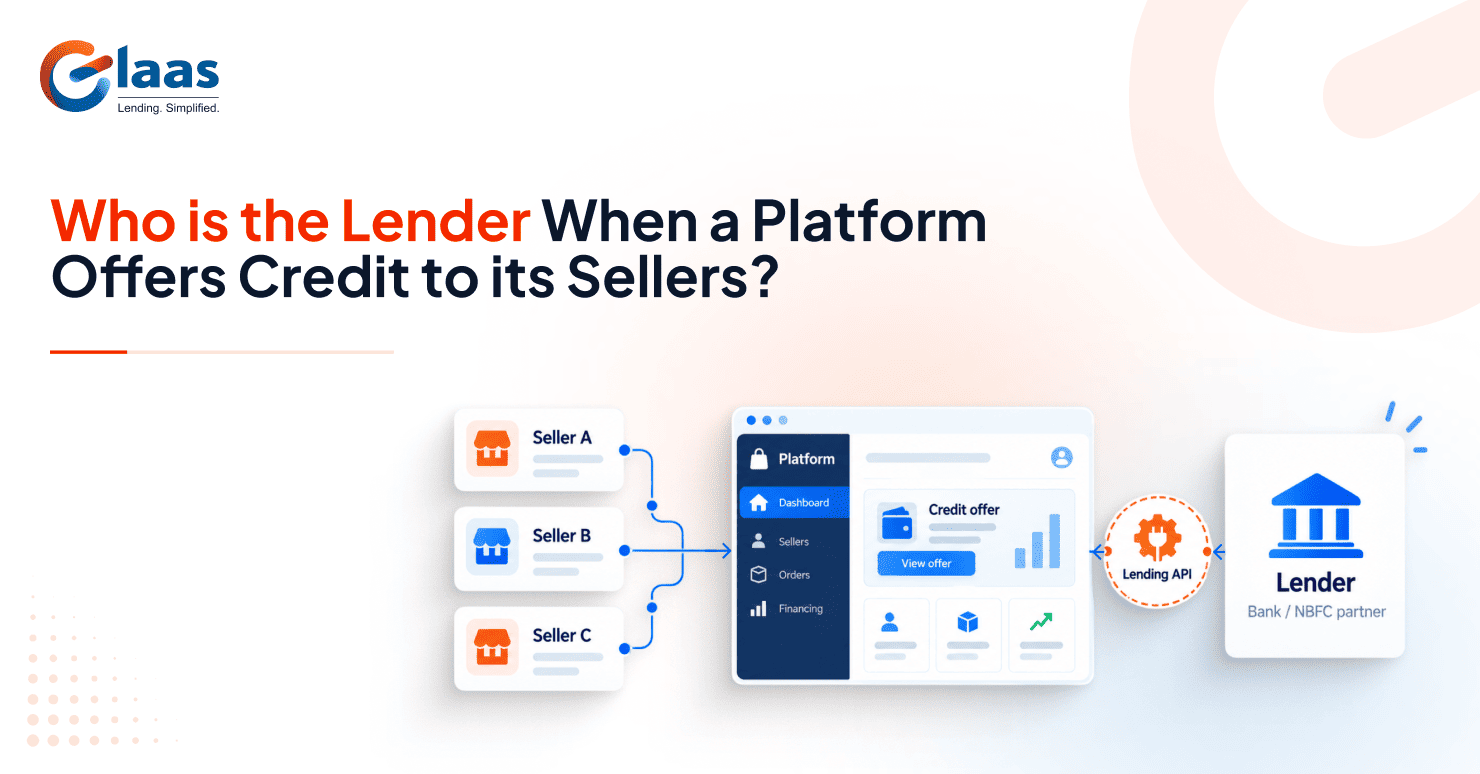
A seller on your platform who needs money between orders will look for it. Ensuring they can find it without leaving your platform is the problem an embedded lending API is built to solve.
It connects your platform to a licensed lender’s systems, so a seller can request working capital, receive a decision, and have money in their account without going elsewhere. A regulated lender does the actual lending. The API puts that product where sellers already manage their orders.
Key Takeaways
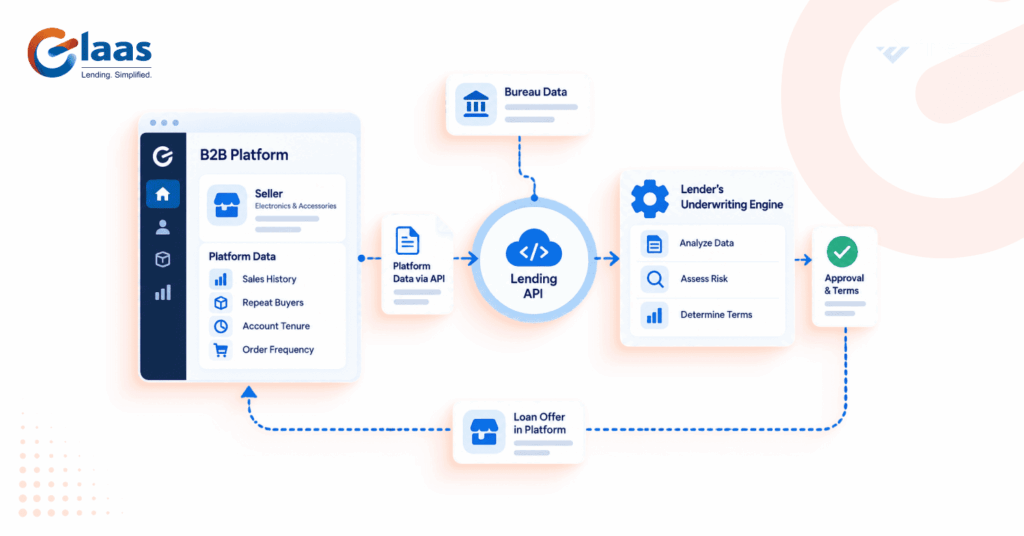
Where the seller has consented, the platform sends their transaction data to the lender’s system. The lender uses it to generate an eligibility assessment or preliminary offer.
The seller expresses interest in the preliminary offer and completes any required identity checks. The lender runs underwriting and, on approval, provides the seller with the final terms and a Key Fact Statement inside the platform.
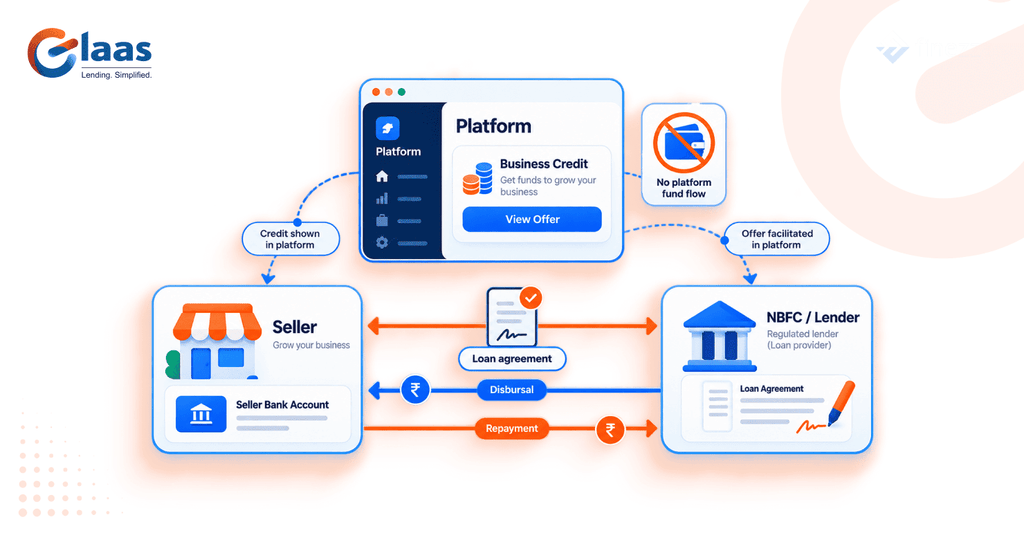
The seller reviews the final terms, accepts, and signs. The lender then disburses directly to their bank account; the platform’s account doesn’t sit in the middle.
Status updates flow back to the platform through the same API connection, keeping the seller’s loan state visible throughout.
Two integration routes: a co-branded option with no platform-side engineering build, live in about days; a fully native white-label option using REST API and webhooks, around a few weeks.
What an Embedded Lending API Actually Connects
Two systems that would otherwise sit apart: your platform, where sellers operate every day, and the lender’s systems, where underwriting, KYC, loan documentation, and disbursement happen. The API connects them.
Where a seller has given prior, explicit consent for their platform data to be shared with the lender, the platform sends that transaction history to the lending system. The lending system uses it to produce an eligibility assessment or preliminary offer. That preliminary offer is not a loan approval. Final approval is a separate step, one that follows the seller completing any required verification and formally accepting the offer. Once that sequence is complete, the money reaches the seller’s bank account and status comes back to your platform.
The result is that the seller handles the whole process inside the platform they’re already using.
The following is an illustrative example of how a revolving credit line works in this kind of integration, based on the seller journey GLAAS documents for this product type. Specific steps, timelines, and required seller actions vary by product, lender, and integration setup.
A seller logs into their dashboard on the platform. A preliminary credit offer is already visible, based on an eligibility assessment run against their transaction history. This isn’t a loan approval; it shows the seller they’re likely eligible and gives them a sense of the available limit.
The seller expresses interest. They see the lender’s identity and the preliminary loan terms before doing anything further. They’re then asked to complete identity verification, which may involve reviewing pre-filled details or providing additional information. This runs through GLAAS’s systems via the API; the platform team doesn’t handle or process it.
Once verification is complete, the seller receives the final approved terms and a Key Fact Statement summarising the loan. They formally accept, e-sign the loan documents, and choose how much to draw and on which repayment plan.
Money arrives in their bank account from the lender. Repayments run over the agreed schedule, managed through the lender’s systems. As they repay, the available limit refreshes for the next draw.
What the Platform Sends, and What Comes Back
The central input the platform provides is the seller’s transaction history: GMV over time, how often they transact, their settlement patterns, how long they’ve been active. This is data the lending system doesn’t have independently, shared subject to the seller’s prior consent.
A bureau score reflects a seller’s borrowing history. Platform transaction data can help the lender assess how that business actually operates today. Incorporating this alongside bureau and other checks can produce a more relevant view of a seller’s credit profile than bureau data alone, though how much weight it carries is a function of the lender’s underwriting policy. Pricing may also reflect that data, depending on how the lender has configured its model for the platform.
What the API carries back:
A preliminary eligibility result, used to populate an offer visible in the seller’s dashboard.
The lender’s credit decision and final approved terms, along with a Key Fact Statement, once the seller has completed verification.
Status confirmation once the seller accepts and signs.
Status updates as the loan moves through disbursal and repayment.
Separately, the platform’s operations team has access to a portfolio dashboard: a real-time view of active loans, repayment rates, and early signals on the book. This is a different interface from the per-seller API responses that drive the seller’s journey through the product.
The platform team doesn’t build the credit model or manage individual accounts. That sits with the lender and its systems.
The Lender’s Role: Offer, Approval, and Disbursal
The offer appears inside the platform’s product, under the platform’s brand or co-branded depending on the integration route. Before the seller accepts anything, they see the lender’s identity and the key loan terms, along with a Key Fact Statement.
Funds flow directly from the licensed lender to the seller’s bank account. Under RBI’s NBFC Credit Facilities Directions, 2025, disbursement must move from the regulated entity to the borrower, not through the platform’s account. Where a co-lending arrangement is in place, the loan documents identify the applicable lenders and their respective roles. The loan agreement is with the lender or co-lenders identified in the loan documents, never the platform.
Whether the platform carries any first-loss exposure depends on its specific role in the arrangement, applicable regulatory limits, and the terms of the agreement it has signed. This involves regulatory requirements and the platform’s eligibility to take that position, not just a commercial negotiation.
Post-disbursal, collections, repayment tracking, and loan servicing are managed by GLAAS on behalf of the lending partner. The platform team doesn’t run that operation.
What Your Platform Needs to Build
How much your team builds, and how long it takes, depends on which route you choose. The distinction matters: the native route requires the platform to integrate with GLAAS’s API; the no-code route uses GLAAS’s infrastructure without any platform-side API build.
Co-branded, no-code
There’s no platform-side engineering build under this route. The provider sets up the seller-facing journey, which runs within the platform’s product with no redirects to an external site. The experience carries a “Powered by GLAAS” co-brand mark. Setup and operational coordination between the platform and the provider still happen before launch, but the platform’s technical team doesn’t build or integrate anything. KYC, loan documentation, servicing, and collections are handled on the provider’s side. A platform can be live in under 2 days under this route.
Fully native (white-label)
The platform connects using the provider’s REST API and webhooks. SDK options are available for iOS, Android, and web. Integration starts in a dedicated sandbox environment; the platform tests the full seller journey before moving to production. Under this route, the seller sees only the platform’s own brand and UX throughout. Going live takes under 2 weeks.
In both cases, the provider manages the underwriting model, KYC workflows, loan documentation, disbursement, collections, and post-loan servicing. The platform’s team doesn’t build or staff any of that.
The choice between routes comes down to speed versus control over the seller-facing interface. The no-code option gets credit in front of sellers faster. The native route takes longer but gives the platform full ownership of how the product appears to sellers.
Choosing the Right Integration Route
The API turns a licensing arrangement into something a seller can actually use. It carries the seller’s transaction data to the lender’s systems, surfaces the decision and offer in the seller’s dashboard, and carries status updates back to the platform. The lender handles disbursement directly to the seller’s bank account, typically within hours of approval.
Platforms like Razorpay and Meesho have built this into their merchant products. If you want to see what it would look like on your own platform, contact us and we’ll map which route fits your current setup.
Frequently Asked Questions
1. Does the platform need its own lending licence to use an embedded lending API?
No. The licensed NBFC or co-lending partner handles the lending. The platform operates under that arrangement without needing its own licence or balance sheet.
2. Does the seller stay inside the platform throughout?
Yes, under both routes. The co-branded journey runs within the platform’s product with a “Powered by GLAAS” mark. The native integration shows only the platform’s own brand and UX. There are no redirects to an external site in either case.
3. What platform data is used for underwriting?
The credit rule engine incorporates the platform’s own transaction data where available and with the seller’s consent: GMV history, settlement patterns, order frequency, and how long the seller has been active. This feeds the underwriting model alongside bureau data. How it is weighted in the final decision depends on the lender’s underwriting policy and the platform’s specific setup.
4. What does GLAAS do and how is it regulated?
GLAAS provides the embedded lending API and the credit technology behind it: underwriting systems, KYC workflows, collection management, and loan lifecycle monitoring. The licensed lender in each arrangement, which may be Gromor Finance or a co-lending partner, is the regulated entity that underwrites and disburses. GLAAS has disbursed ₹1,500 Cr+ across 110,000 loans to 13,000+ MSME borrowers, with seven in ten borrowers returning for another loan.
A platform introducing a seller-credit offering inside its existing app needs one question answered before it goes live: when a seller borrows through that offering, who are they really borrowing from?
If the arrangement is set up the standard way, a licensed NBFC is the lender, not the platform. The NBFC approves the loan, disburses it, and carries the risk if the seller doesn’t repay. The platform’s job is tobring the offering to sellers inside its own app and support the NBFC’s process, typically by supplying transaction data that helps it underwrite faster.
That answer settles who lends. It doesn’t settle what the platform itself is responsible for, and that gap is where platforms run into trouble.
Two signs mean the arrangement has drifted from that standard structure, whatever the partnership deck calls it:
The loan agreement identifies the platform, rather than the NBFC, as the lender.
Repayments pass through the platform’s own bank account before reaching the NBFC.
Key Takeaways
The licensed NBFC is the lender of record. It signs the loan agreement, disburses the funds, and carries the credit risk unless it has separately agreed to share part of that risk.
The platform’s role is that of a Lending Service Provider (LSP), an agent whose specific functions are set by its written contract with the NBFC, not by the LSP label alone.
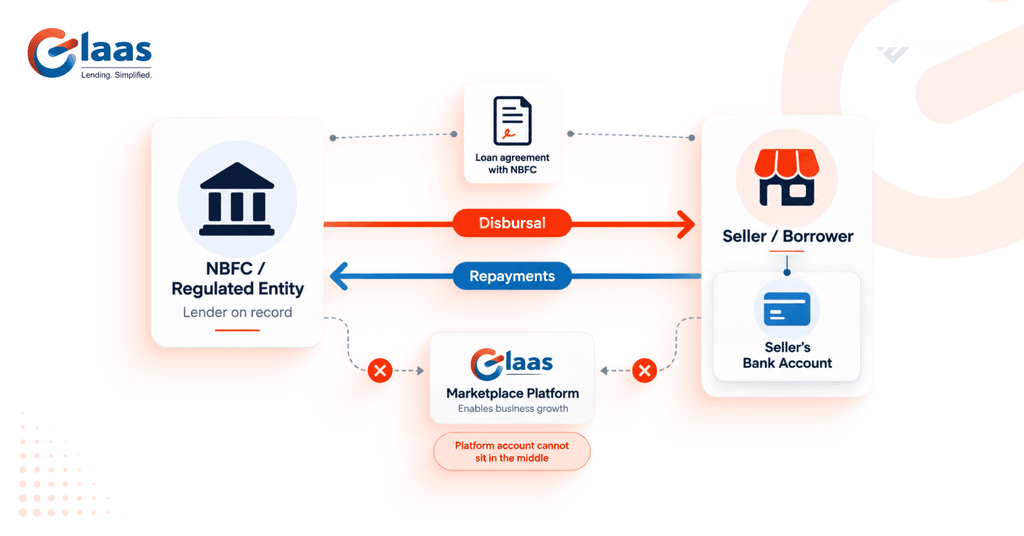
RBI’s rules bar the platform’s own account from acting as a pass-through for disbursal or repayment. Both move directly between the NBFC and the seller’s bank account.
A platform only shares in a seller’s default loss if it has separately agreed to a Default Loss Guarantee (DLG), capped by RBI at 5% of the amount disbursed under that specific loan portfolio.
Not bearing default loss doesn’t mean the platform has no responsibilities. Under its LSP agreement, it may still handle onboarding, underwriting support, or collections outreach, work that continues whether or not a DLG is in place.
RBI holds the NBFC responsible for everything its LSP does on its behalf, including the platform’s conduct with sellers.
Does Offering Sellers Credit Make Your Platform a Lender?
No, not when the credit runs through a licensed NBFC partner. The loan stays on the NBFC’s books because the NBFC is the one that approves it, signs for it, and funds it from its own balance sheet. The platform just connects the seller to the NBFC and supports the process along the way, without extending the credit itself.
On the flip side, a platform lending on its own account would need to register as an NBFC. Registration turns on how much of a company’s business is financial in nature, measured by the share of its total assets and gross income coming from financial activity, not by whether it uses its own funds.
Who is a Lending Service Provider Under RBI’s Rules?
A platform becomes that agent by taking on one or more functions under its contract with the NBFC, such as bringing in customers, supporting underwriting, servicing a loan, or helping with recovery. Which functions it actually performs is set by that contract, not assumed from the LSP label.
What doesn’t move, regardless of the contract, is the lending decision itself: the NBFC underwrites and approves each loan, and a platform doesn’t take on credit risk simply by performing these functions well. Taking on part of that risk needs a separate written arrangement, covered further down.
Who Signs the Loan Agreement, and Where Does the Money Move?
Two things happen in this arrangement, and they’re worth keeping apart: who the seller’s loan agreement is with, and which bank accounts the money moves through.
The seller signs the loan agreement with the NBFC. RBI’s rules require this document to name the actual lender, not the platform the seller uses day to day.
Money follows the same principle: the NBFC disburses funds directly into the seller’s bank account, and the seller repays the NBFC the same way. RBI’s rules bar the platform’s own account from acting as this kind of pass-through, or pool account, for either leg, with narrow exceptions such as co-lending.
None of this stops a platform building the experience inside its own interface. A seller can see an offer, work through the paperwork, and track repayments without leaving the platform’s app, under the platform’s own branding. What’s shown on screen is a design choice, separate from who’s lending and where the money moves; both stay directly between the seller and the NBFC.
What Happens If a Seller Misses a Repayment?
A missed payment, an account moving into collections, and a realized default loss are different points on the same timeline, and RBI treats them differently.
When a seller misses a payment, the NBFC’s collections process takes over first, sometimes run through the platform acting as its LSP under specific written instruction. If the seller still hasn’t caught up, RBI requires the NBFC to invoke any agreed Default Loss Guarantee within a maximum overdue period of 120 days, rather than waiting for a formal write-off.
Whichever point it’s resolved at, the underlying loss falls to the NBFC by default: it’s the lender of record, and it absorbs a seller’s default unless it has separately agreed to share part of that loss.
A platform can take on part of that loss only through a separate, explicit Default Loss Guarantee, or DLG, under which it commits upfront, as the NBFC’s LSP, to compensate the NBFC for a defined share of losses on a specific loan portfolio.
Not every platform qualifies: RBI requires a DLG provider to be incorporated as a company, and the NBFC must complete its own eligibility and due-diligence checks before entering the arrangement. RBI also caps the cover itself: under Chapter III of the Directions, a DLG can’t exceed 5% of the amount disbursed under the specific portfolio it covers, tracked at any given point in time, not 5% of the platform’s total book.
A platform without a DLG doesn’t inherit any of this by default. One that has signed a DLG takes on a defined, capped share of losses on the named portfolio, nothing broader.
What Should You Confirm With a Lending Partner Before You Go Live?
These four checks are worth running through with any NBFC partner before a seller credit offering goes live.
1. Role and Paperwork
Confirm the written contract required under RBI’s rules spells out which functions the platform performs (sourcing, underwriting support, servicing, recovery) and which stay with the NBFC. An agreement that doesn’t name these clearly leaves both parties guessing who’s accountable if RBI, or a seller, raises a complaint.
2. Loan Agreement Ownership
Check who’s named as the lender on the loan agreement itself, and how the platform’s own role is described elsewhere in the document. If either is unclear, or the platform is described in a way that could read as a lending party, that needs fixing before launch, not after a regulator or a seller raises it.
3. Money Flow
Ask which bank accounts disbursement and repayment move through, on both sides of the transaction. Funds routing through the platform’s own account, even briefly, is a pass-through arrangement RBI’s rules don’t permit for a standard NBFC-LSP structure, and it’s worth catching at the contract stage rather than after go-live.
4. Default Handling
Ask two separate questions: who follows up when a seller misses a payment, and whether the platform has agreed to a Default Loss Guarantee. If a DLG is part of the deal, get the exact loan portfolio it applies to and the percentage of that portfolio’s disbursed amount it covers, in writing, rather than a general sense of “coverage.”
Where This Leaves Your Platform
A platform offering seller credit through a licensed NBFC doesn’t need to become a lender to keep sellers funded and orders flowing. What it needs from a partner is paperwork that matches that structure: the NBFC’s name on the loan and its account handling the money, with default terms already agreed before a seller ever misses a payment.
GLAAS builds that structure for digital platforms. In the arrangement this article describes, Gromor Finance, GLAAS’s own licensed NBFC, is the lender, underwriting off the platform’s own transaction data rather than relying on bureau scores alone. Other GLAAS arrangements may involve additional regulated lenders as co-lending partners. Platforms have gone live with a co-branded, no-code credit product in under two days, and seven in ten GLAAS borrowers come back for a second loan.
If you’re weighing this for your own platform, talk to GLAAS about what a seller credit line built on your transaction data would look like.
Frequently Asked Questions
1. What is a lending service provider (LSP) in India?
An LSP is an agent that carries out specific digital lending functions, such as customer acquisition or loan servicing, on behalf of an NBFC, under a written contract. RBI’s Non-Banking Financial Companies – Credit Facilities Directions, 2025 govern this relationship.
2. Is a platform considered the lender when it offers credit through a licensed NBFC partner?
No. In this arrangement, the NBFC is the lender of record. It signs the loan agreement, disburses the funds, and carries the credit risk by default. The platform acts as the NBFC’s agent, not as a party to the loan.
3. Does a platform need an RBI licence to work with a lending service provider structure?
A platform does not need its own NBFC registration for the licensed-partner arrangement described here. A different lending model needs a separate assessment under RBI’s rules.
4. What happens if a seller misses a repayment under this structure?
The NBFC’s collections process runs first, sometimes through the platform acting as its LSP. If the loan isn’t recovered, the resulting loss stays with the NBFC by default, unless it has separately agreed to a Default Loss Guarantee (DLG) with the platform, capped by RBI at 5% of the amount disbursed under the specific loan portfolio the DLG covers.
5. What does GLAAS do, and how is it regulated?
GLAAS builds the technology that lets digital platforms embed seller credit inside their own apps, using each platform’s transaction data to underwrite. In this arrangement, Gromor Finance, GLAAS’s own licensed NBFC, is the lender; other GLAAS arrangements may involve additional regulated lenders as co-lending partners.
Sellers facing a cash flow crunch between orders will find funding elsewhere, taking their next transaction to whichever rival platform or lender helps them first.
Embedding working capital directly into your B2B marketplace prevents this vendor drift, keeping your users active and protecting your own transaction volume.
While these projects frequently feel overwhelming due to RBI compliance and the complexities of holding a licence, the regulatory reality is simple: your marketplace does not need to become a lender to offer credit.
Key Takeaways
A marketplace needs an NBFC licence only if it expects lending to become its principal business, funded from its own balance sheet.
The route almost every platform takes instead is partnering with a licensed NBFC as a Lending Service Provider, a structure RBI recognises under its Digital Lending Directions, 2025.
The NBFC remains the lender of record. Loan money moves between the NBFC and the seller’s bank account, never through the platform’s account.
Credit risk sits with the NBFC unless the platform agrees to a default loss guarantee, which RBI caps at 5% of the loan portfolio.
What separates partners isn’t the licence they may hold. It’s whether they underwrite on your platform’s data and how fast they can move.
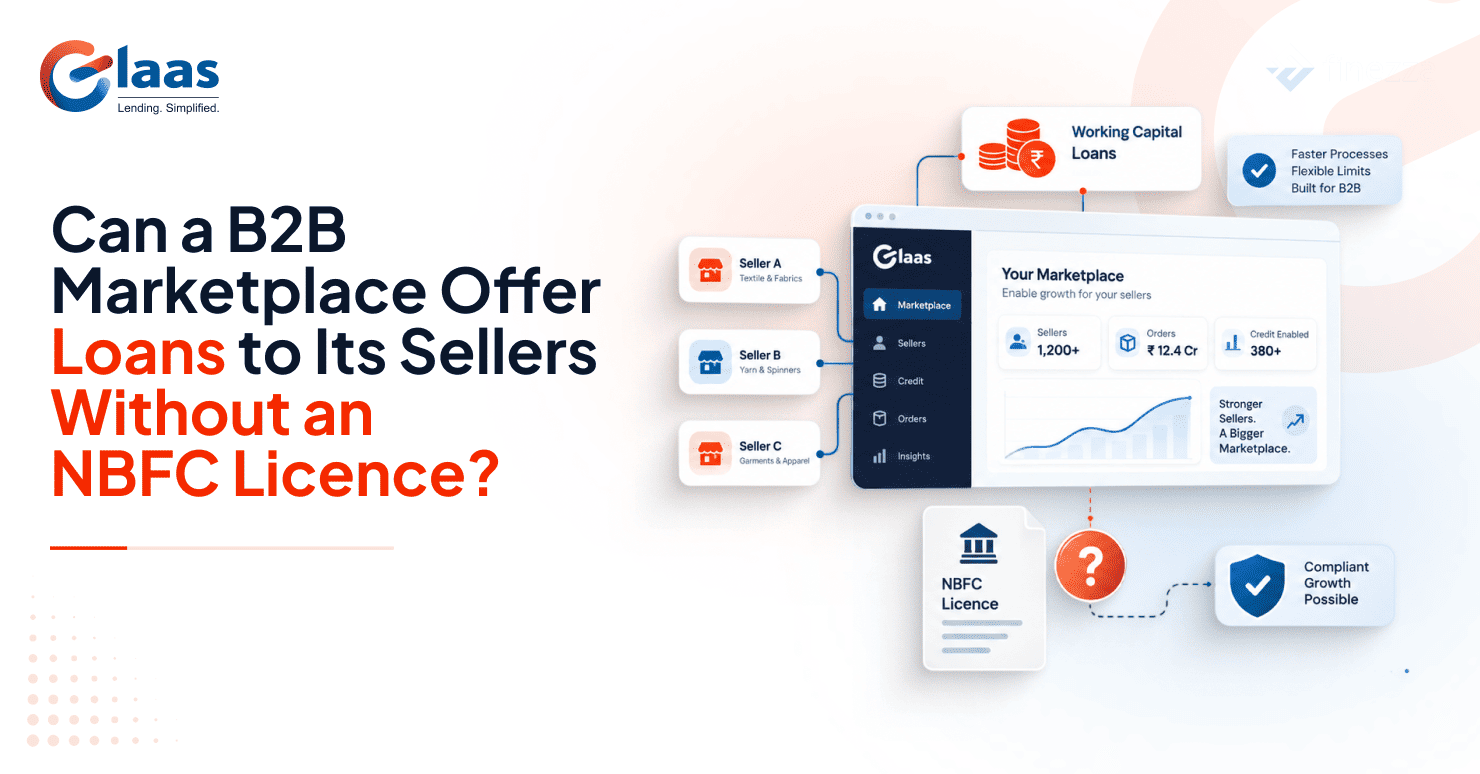
Does a B2B Marketplace Need an NBFC Licence to Offer Credit?
No, as long as it isn’t the one putting up the money.
Section 45-IA of the RBI Act, 1934 requires a company to register before it can carry on the business of a non-banking financial institution. RBI’s test for whether you’ve crossed into that: do more than half your assets and more than half your income come from financial activity? If lending is running alongside your actual business rather than being your actual business, you’re on the right side of it.
A platform extending small amounts of trade credit to a handful of sellers from its own funds is unlikely to be there. A platform funding a standing credit line for every seller on it, out of its own money, qualifies as “financial activity,” no matter what the internal team calls the product. And this isn’t a rule worth testing while you check for demand. Section 58B(4A) makes contravention punishable with a jail term of 1-5 years, plus a fine of ₹1 lakh to ₹5 lakh.
Could a platform just get the licence itself?
It can, but it’s a separate business from the one you already run: fresh capital, a minimum ₹10 crore in net owned funds, paperwork with RBI, and ongoing compliance once you’re registered, not a one-time cost. Practitioners put the full timeline at 8 to 14 months before a rupee gets disbursed.
RBI’s Amendment Directions of 29 April 2026, effective 1 July 2026, make one exemption: NBFCs under ₹1,000 crore in assets that take no public funds and have no customer interface. A marketplace lending to its own sellers has a customer interface by definition, so this exemption doesn’t apply. There’s no small-scale version to start with and grow out of, registration is mandatory regardless of size.
What’s the Alternative, and How Does It Work?
The alternative is to work with a company that already holds the licence and operate under it as its lending service provider.
RBI’s Digital Lending Directions, 2025, effective 8 May 2025, set this structure out formally. A Lending Service Provider acts as agent of a Regulated Entity, which is a licensed bank or NBFC, and handles digital lending functions on its behalf: bringing in customers, supporting underwriting, servicing, monitoring, recovery. All of it under a written contract. The marketplace becomes the LSP. The NBFC stays the Regulated Entity, and it keeps everything that comes with holding a licence.
Worth being clear on one point, because it’s where platforms sometimes assume more freedom than they have: the Regulated Entity stays answerable to RBI for what its LSP does in its name. Outsourcing a function doesn’t outsource the accountability for it.
Who Actually Lends the Money, and Where Does It Go?
The NBFC is the lender on record, and the money moves directly between the NBFC and the seller’s bank account.
Under the same 2025 Directions, disbursal has to move from the Regulated Entity to the borrower’s account and repayments have to travel back the same way, with narrow exceptions set out in the Directions. The platform’s own account can’t sit in the middle as a pass-through, and the loan agreement the seller signs is with the NBFC.
For the platform, that’s less of a constraint than it sounds. Credit appears inside the seller’s existing experience, on the marketplace’s brand, while the money and the paperwork route around it.
What Should You Check in an NBFC Partner for Embedded Finance?
Establishing the licence isn’t the deciding factor. What separates one partner from another is the operating detail underneath it.
Underwriting depth: A partner scoring purely off bureau data is offering the same product a seller could get by walking into a bank. Underwriting that factors in GMV, repeat-customer behaviour, bank flow, and months active gets closer to how the seller’s business actually runs.
Integration speed: A co-branded, no-code product can go live in under 2 days, a fully native integration in around 2 weeks. Match the option to how urgently your sellers need credit, not to which one looks more polished in a demo.
Contract clarity: RBI’s 2025 Directions expect a written contract with defined roles and responsibilities, backed by proper due diligence between the Regulated Entity and its LSP.
Balance sheet capacity: A single NBFC’s balance sheet has limits of its own. A partner built to add co-lending relationships later means your seller credit doesn’t get capped by what one lender is willing to underwrite.
This is where GLAAS comes in. It works for the platforms running underwriting on the platform’s own data rather than bureau data alone.
GLAAS has disbursed more than ₹1,500 crore across 110,000+ loans to over 13,000 MSMEs (micro, small, and medium enterprises) through its platform partners, with 7 in 10 borrowers returningfor a second loan. Numbers like that are one way to tell whether a partner has run this at scale, not just built the technology for it.
What Your Marketplace Carries, and What It Doesn’t
By default, the credit risk sits with the NBFC. When a seller falls behind, the NBFC’s own collections and recovery process takes over, and it stays off your marketplace’s books unless a default loss guarantee says otherwise.
That default has a qualifier, and any partner who glides past it is selling rather than explaining. Chapter VI of the 2025 Directions permits a Regulated Entity to enter a default loss guarantee arrangement with its LSP, which means a platform can be asked to cover first loss on part of the book. RBI caps that at 5% of the underlying loan portfolio. The LSP offering it has to be incorporated under the Companies Act, 2013. Cover can only be held as cash, a lien-marked fixed deposit, or a bank guarantee. And it has to be invoked within 120 days of an account going overdue.
So the accurate version is: a marketplace can run seller credit with nothing on its own balance sheet, and many do. Whether it carries any first loss is a commercial term someone negotiates, not something the regulation settles for you. Ask about it in the first conversation rather than the fourth.
Where This Leaves Your Platform
A marketplace doesn’t need to become a lender. It needs to choose one. The harder question comes after that: does this partner underwrite on your platform’s own transaction data? Can it approve a seller fast enough to matter, before that seller goes looking elsewhere?
GLAAS is built for that seat. It runs the technology in the LSP layer, and Gromor Finance, its own NBFC, is the Regulated Entity that lends. Platforms go live with a credit product under their own brand, on a no-code embed, in under two days.
If you’re working through this for your own platform, contact us now, and we’ll map what a seller credit line built on your transaction data would look like. No licence required on your end.
Frequently Asked Questions
1. Does a B2B marketplace need an NBFC licence to lend to its sellers?
No, not if it partners with a licensed NBFC instead of lending from its own balance sheet. It operates as a Lending Service Provider, handling seller-facing functions like data sharing and onboarding, while the NBFC extends the credit and carries the risk.
2. When would a marketplace need to register as an NBFC?
Once lending becomes its own principal business: RBI’s test is whether more than half a company’s assets and income come from financial activity. Most platforms offering embedded credit through a partner never cross that line.
3. What is a Lending Service Provider (LSP) under RBI’s rules?
An LSP is an agent that performs functions like customer acquisition, underwriting support, servicing, or recovery on behalf of a Regulated Entity, under a contract. RBI’s Digital Lending Directions, 2025 govern this relationship, and the Regulated Entity stays fully accountable for what its LSP does.
4. What does GLAAS do, and how is it regulated?
GLAAS operates as a Lending Service Provider under RBI’s Digital Lending Directions, 2025. Its NBFC, Gromor Finance, is the Regulated Entity that carries the credit risk, using the marketplace’s own transaction data to underwrite rather than bureau scores alone. GLAAS has disbursed over ₹1,500 crore across 110,000+ loans to 13,000 MSMEs for platforms like Meesho and Razorpay, with seven in ten borrowers returning for a second loan.